

Google Ads for Real Estate Agents: When They Make Sense (And When They Don't)
BrickByBrick Productions
Learn when Google Ads for real estate agents make sense, discover accurate budget benchmarks for 2026, and avoid the landing page mistakes wasting your spend.
Deciding where to allocate your marketing budget can feel like a high-stakes guessing game. You have likely heard stories of real estate agents pulling dozens of high-end listings from paid search, right alongside horror stories of professionals burning through thousands of dollars with nothing to show for it but spam forms.
It is completely normal to feel cautious about paid traffic, especially when your hard-earned commissions are on the line. Navigating the conflicting advice around online advertising while trying to maintain a predictable business flow can be incredibly stressful.
Paid advertising is neither a magic cure nor a complete waste of money; it is simply a tool that requires specific market conditions to yield a positive return. To protect your marketing budget, you need to know exactly when deploying Google Ads for real estate agents makes financial sense, and when you should rely on organic channels instead.
When Paid Search Worth the Investment
Paid search advertising functions like a faucet: the moment you turn it on and pay, leads begin to flow, but the moment you stop paying, the volume drops to zero. This makes it ideal for real estate agents who need to fill immediate pipeline gaps or those operating in hyper-competitive luxury markets.
If you are expanding into a new premium territory where you currently have zero local market presence, organic search optimization can take months to build authority. Paid campaigns allow you to instantly jump to the top of search results for high-intent buyer phrases.
Scenarios Where Paid Ads Make Sense:
Immediate Transactional Needs: You have a specific revenue goal for the next sixty days and need active buyers immediately.
High-Margin Markets: Your local average sales price is high enough that closing just one transaction easily covers your annual advertising spend.
Specific Subdivisions: You are targeting buyers looking for highly specific keywords like "luxury golf course homes in [City]."
To see how top producers balance paid visibility with long-term brand equity, explore our comprehensive guide on Effective Real Estate Marketing Strategies.
Understanding the True Cost: 2026 Benchmarks
A major point of confusion for many professionals is the actual execution cost of real estate PPC advertising. Entering paid auctions without knowing your numbers is a fast track to wasting your ad spend.
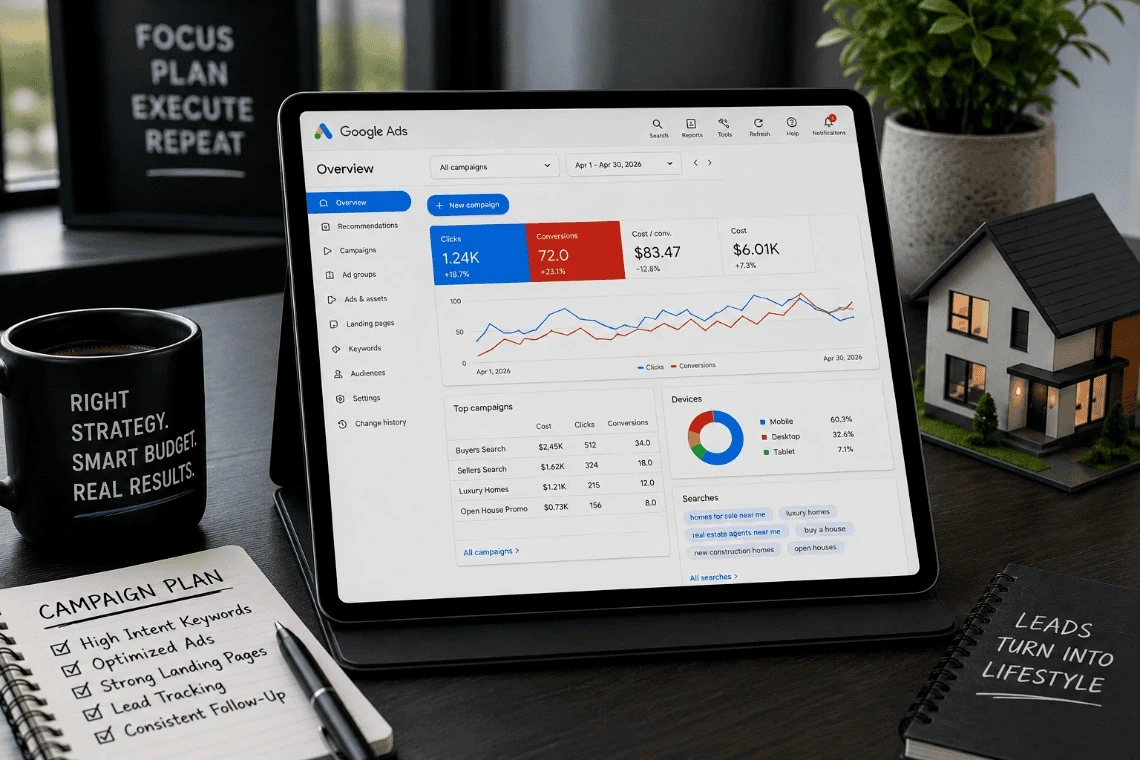
In the current landscape, the average Google Ads cost per lead real estate campaigns generate varies wildly based on location, competition, and asset class. On average across North America, you can expect a cost-per-click (CPC) ranging from $3.00 to over $12.00 for highly competitive buyer keywords.
Because not every click converts into a phone call, your final cost per lead typically balances between $40.00 and $150.00. This math means you must have a high-converting follow-up system in place to ensure you successfully convert those leads into signed clients.
Landing Page Mistakes That Waste Your Budget
The biggest reason real estate agents lose money on paid search has nothing to do with the ad itself. The breakdown almost always happens on the page where the user lands after clicking your link.
Sending paid traffic directly to the homepage of your standard website is a critical mistake. If a buyer searches for "new construction townhomes" and arrives on a generic homepage displaying your bio and a general search bar, they will leave within seconds.
Common Paid Search Traps to Avoid:
Generic Contact Forms: Forcing a user to register before showing them any property details causes immediate abandonment.
Slow Loading Times: If your landing page takes more than three seconds to load, you are paying for clicks that never see your content.
Mismatched Search Intent: Your ad promises a list of luxury foreclosures, but your landing page shows standard suburban listings.
If you want to build a web presence that organically converts visitors without relying completely on paid clicks, learn the technical frameworks in our manual on how to Build Real Estate Website.
Running Paid Ads Alongside Organic Strategy
If you are wondering, should realtors use Google Ads if they already have an organic channel, the answer is an absolute yes. When deployed correctly, paid campaigns and organic content work together without cannibalizing each other.
A sophisticated real estate Google Ads strategy uses paid search to capture immediate, short-term transactions while your organic content builds long-term authority. For instance, you can use paid ads to target hot buyer leads while simultaneously publishing neighborhood guides on YouTube to build permanent trust.
This dual-platform approach ensures you capture consumers at every stage of their home search. We frequently break down how top teams manage this multichannel balance on our LinkedIn company page.
You can also study visual examples of how text ads can naturally complement video positioning by reviewing the case studies on our official Instagram feed.
From Traffic to Predictable Growth
At this point, you might be thinking about how to properly structure your initial paid search campaigns to avoid wasting money. While the math behind paid lead acquisition is straightforward, setting up custom ad groups, monitoring negative keywords, and designing dedicated landing pages is incredibly complex.
This implementation gap is where most real estate agents hit a wall. Managing active keyword bids, split-testing ad copy, and tracking conversion pixels quickly turns into a series of time-consuming processes that pull you away from showing properties and negotiating listings.
Trying to act as a full-time media buyer alongside your daily real estate operations often creates an exhausting cycle of volatile ad spend and inconsistent lead quality. True business scaling requires professional leverage, not more manual management from you.
If you want a predictable system that builds an automated client acquisition engine without the stress of managing ad managers yourself, we can build it for you. We design comprehensive marketing systems that combine advanced optimization with high-converting search strategies, a model that has helped our clients clear 1,100+ leads generated and close over $130,000,000 in sales through YouTube.
If you are ready to turn your digital marketing into a predictable process, then:
Schedule Your Strategy Call → brickbybrick.productions
Performance metrics depend entirely on local market competition, budget allocation, and consistent lead follow-up. The benchmarks detailed above reflect what is currently driving measurable opportunities for real estate agents across North America in 2026.